We heard the future weeping, and we didn’t turn away

20 Apr 2026
Celebrating seven years since the launch of CDE
It’s seven years this month since Culture Declares Emergency was launched, back in April 2019. As the world shifts dramatically and our movement adapts and evolves in response, it is tempting to keep looking forward – and easy to forget that looking back is a generative, grounding and necessary practice.
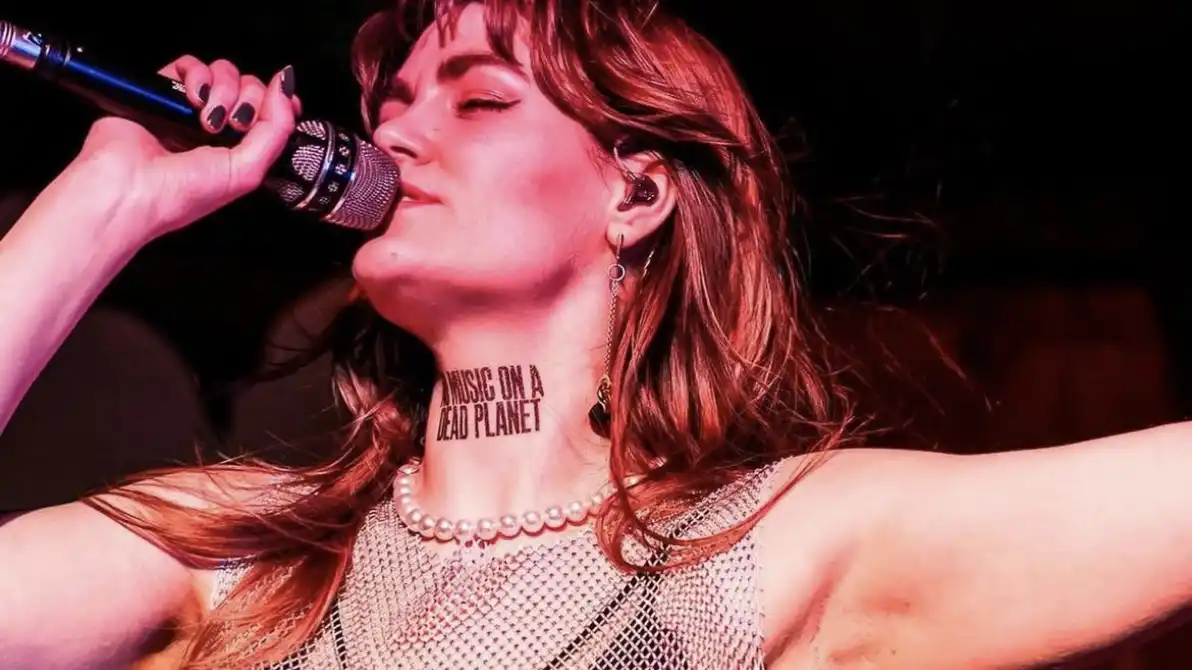
So much has happened over the past seven years. We’ve grown into a community of 1,861 Declaring individuals and organisations, have catalysed a ‘movement of movements’ with groups like Music Declares Emergency and Business Declares taking the world by storm; we’ve held consciousness-raising and story-shattering actions in the heart of some of the UK’s biggest cultural institutions, shared wisdom with grassroots groups mobilising across the Earth, and nurtured a mycelial network of change-makers within and beyond the arts.
Like so many groups working at the intersection of arts and climate justice, we are working in under-funded, precarious contexts. We currently find ourselves in a quieter, fallow period as we await the outcome of funding applications and reimagine what CDE can do with limited resources. This feels like the right moment to celebrate our past and our legacy, in order to gather momentum for the journey ahead. We look back (and below) to acknowledge the very fertile soil that we have cultivated over the years, and trust in what will continue to sprout from this soil for years to come.
It would be impossible to capture the innumerable ripples that CDE has generated since its inception, but through conversations with a few of our elders and founders, we’ve woven together some of our biggest stories and impacts.
The beginning
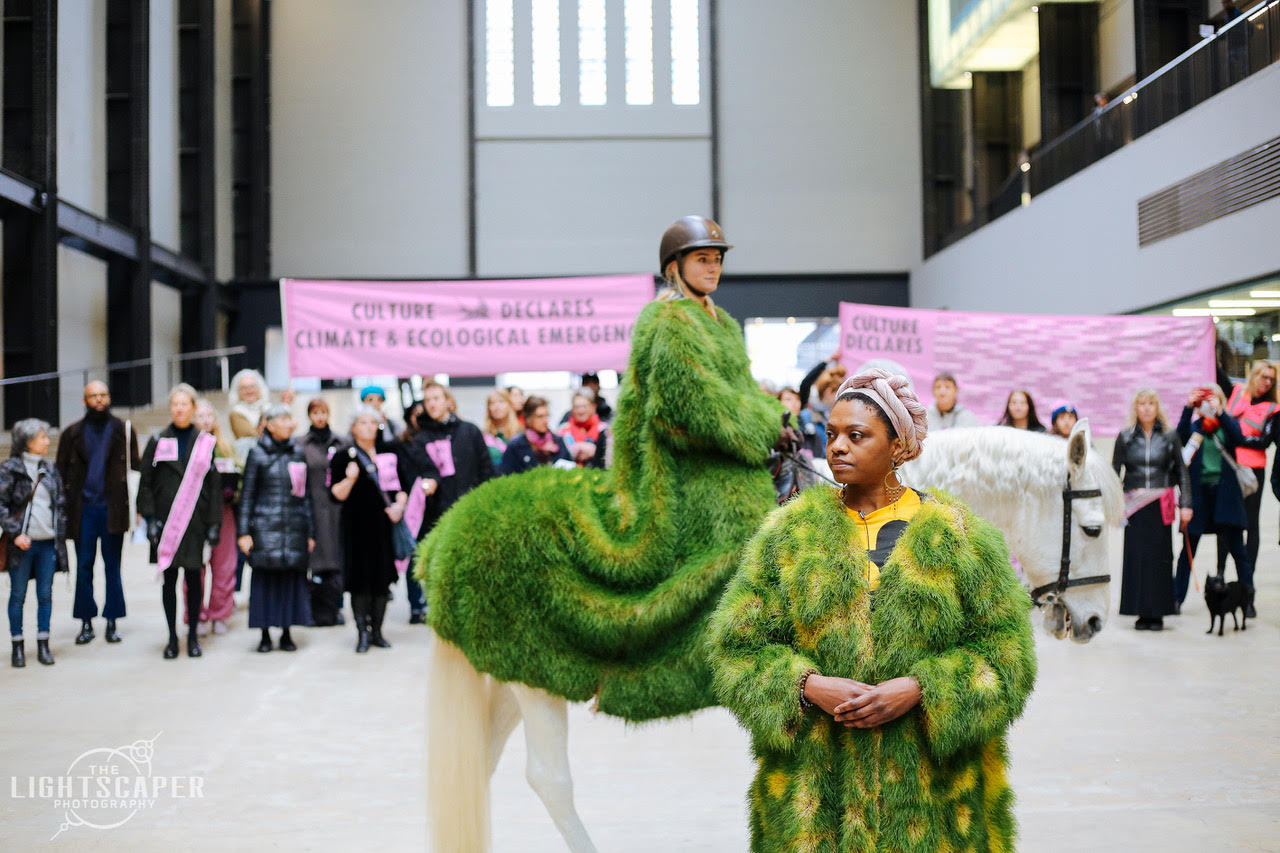
In March 2019, planning meetings began with folks including Bridget McKenzie, Ruth Ben-Tovim, Lucy Neal, Kay Michael, Ackroyd & Harvey and many more. We kicked off with a spectacular procession around some of London’s major cultural institutions, with su/pport from Extinction Rebellion. A horse with rider swathed in a living grass coat led a collective of 60 artists-activists declaring, “There is no doubt. Humanity faces the combined catastrophes of global heating and mass extinction of biodiversity. We are Culture Declares Emergency and we invite you to join us!”
That year we also gathered hundreds for a cultural assembly at the Roundhouse to discuss, within community, the role of arts and culture in turning around the Earth crisis. This was followed by events such as a Rally of the Imagination, the Festival of Change in Brighton, a public call to write Letters to the Earth, and many more.
“I was working at Theatre de Complicité and saw an email about the CDE launch event at Tate Modern. It felt so relevant for the company at that time, and for me personally, that I immediately got in touch and asked how we could help. That was the start of a rollercoaster ride to produce the first cultural assembly which brought together hundreds of people at the Roundhouse in Camden. It was an amazing day of head and heart, of challenge and empathy and mutual support. I’ve met so many people who said that things changed for them at that event and I was very proud to be a part of it.” – Polly Gifford
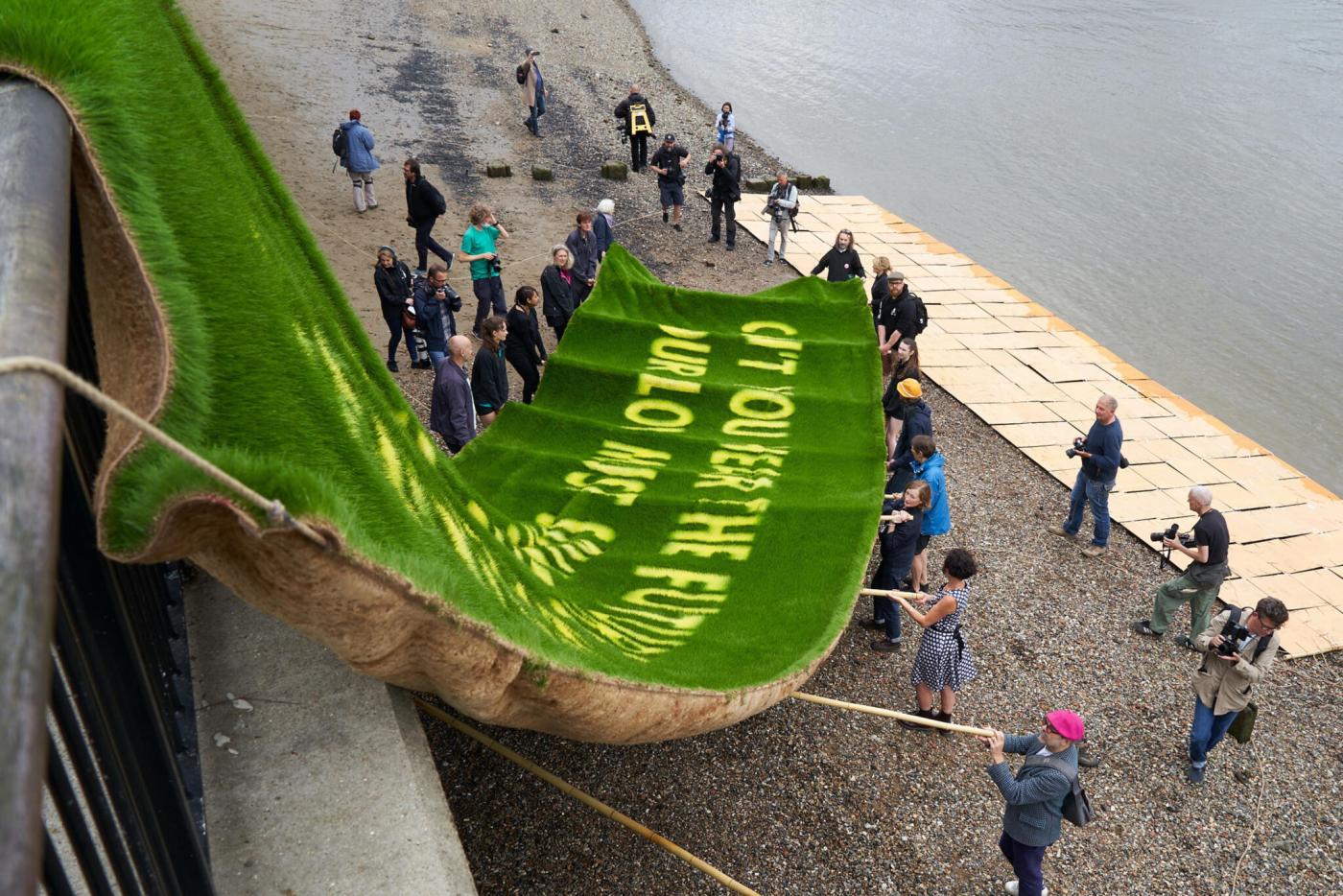
An unforgettable intervention was On The Shore, a stunning visual art and literature collaboration between artists Ackroyd & Harvey and poet, novelist and activist Ben Okri, and our comrades at Writers Rebel.
Over ten days in 2021, Ackroyd & Harvey grew a grassy pelt 16 metres long from a bed of woven hessian stretched across the floor of Tate Modern’s Turbine Hall. Imprinted into its surface were the visionary words of Ben Okri: “Can’t you hear the future weeping? Our love must save the world.”
“The images of those events are burnt into my consciousness.” – Victoria Burns
The power in assembling and Declaring
The Tate under Francis Morris was an incredible partner and organisational role model, making its declaration in July 2019. Following engagement with the Tate, we continued our work engaging with other major cultural institutions and associations, leading to declarations by the likes of the Natural History Museum and the Southbank Centre.
“The assemblies at De La Warr Pavilion, the Southbank Centre, the original one at the Roundhouse in London, and the follow-up online were real highlights. They felt like moments when the work actually took form, not just discussion, but people in the same space trying to deeply explore how adaptation, care, and place-based community can manifest.” – Victoria Burns
Whilst cultural institutions began waking up to their responsibility to tell truths about the Earth crisis, hundreds of passionate, dedicated, creative individuals began writing their Declarations.
“Making a public declaration had a profound and empowering effect on me and has motivated me to continue working in the nexus of culture and climate regardless of the daily news, the setbacks and the disappointments. I always carry radical hope as my travelling companion, and CDE principles continue to inform my work.” – Julie Ward
Declaring is a powerful, cathartic process that works to ritualise our commitment to a beautiful, thriving Earth.
“The declarations are beautiful – the acknowledgement of climate, nature, and ecological breakdown and the individual commitments to action and change.” – Jill Howitt
Seeding a movement of movements
We were the first Declaring initiative for any professional sector, inspiring the formation of many other declarer movements across different sectors as we led a call to create a ‘movement of movements’. Other Declaring groups then sprung up within design, heritage, architecture, music, tourism, health and business, and we nurtured this Alliance of Declarers.
“Our impact lies in the flowering of initiatives in the wake of our founding. We saw the mushrooming of multiple Declarer groups across and beyond the Cultural sector, and we convened several gatherings and strategic campaigns with this Alliance of Declarers. We also saw the founding of Culture Declares groups internationally, on every continent, a network that we also nurtured and supported. We were also able to fund and nurture many regional Culture Declares networks, gatherings and alliances. There must be thousands of seeds of awareness and action pollinated from this, expanding ideas about what Arts and Culture can do in response to the Earth Crisis.” – Bridget McKenzie
Reframing the Earth crisis as a crisis of culture
Central to our work has been reframing the Earth crisis as fundamentally a crisis of culture.
Culture shapes the stories we tell of ourselves, the values we hold, and the way we relate to the world. Dominant culture upholds separation, individualism, extraction, wealth, and power. We believe that in order to build a more caring, ecologically thriving world, we must shift these stories, values and worldviews. Herein lies the role of arts and culture.
Whilst we’ve been banging this drum since 2019, it is uplifting to now see culture placed at the forefront of conversations about climate and ecological collapse, with cultural action finally being formalised in international climate negotiations, and regular conferences and gatherings taking place across the country to discuss the role of cultural organisations in generating place-based adaptation to crisis.
We have demanded that adaptation, care, and place-based community be centred as the lived context in which responses to the crisis actually unfold. Our model of establishing regional Hubs allowed communities to engage in tangible practices of place-based adaptation and resilience.
Community at the core: weaving a mycelial network
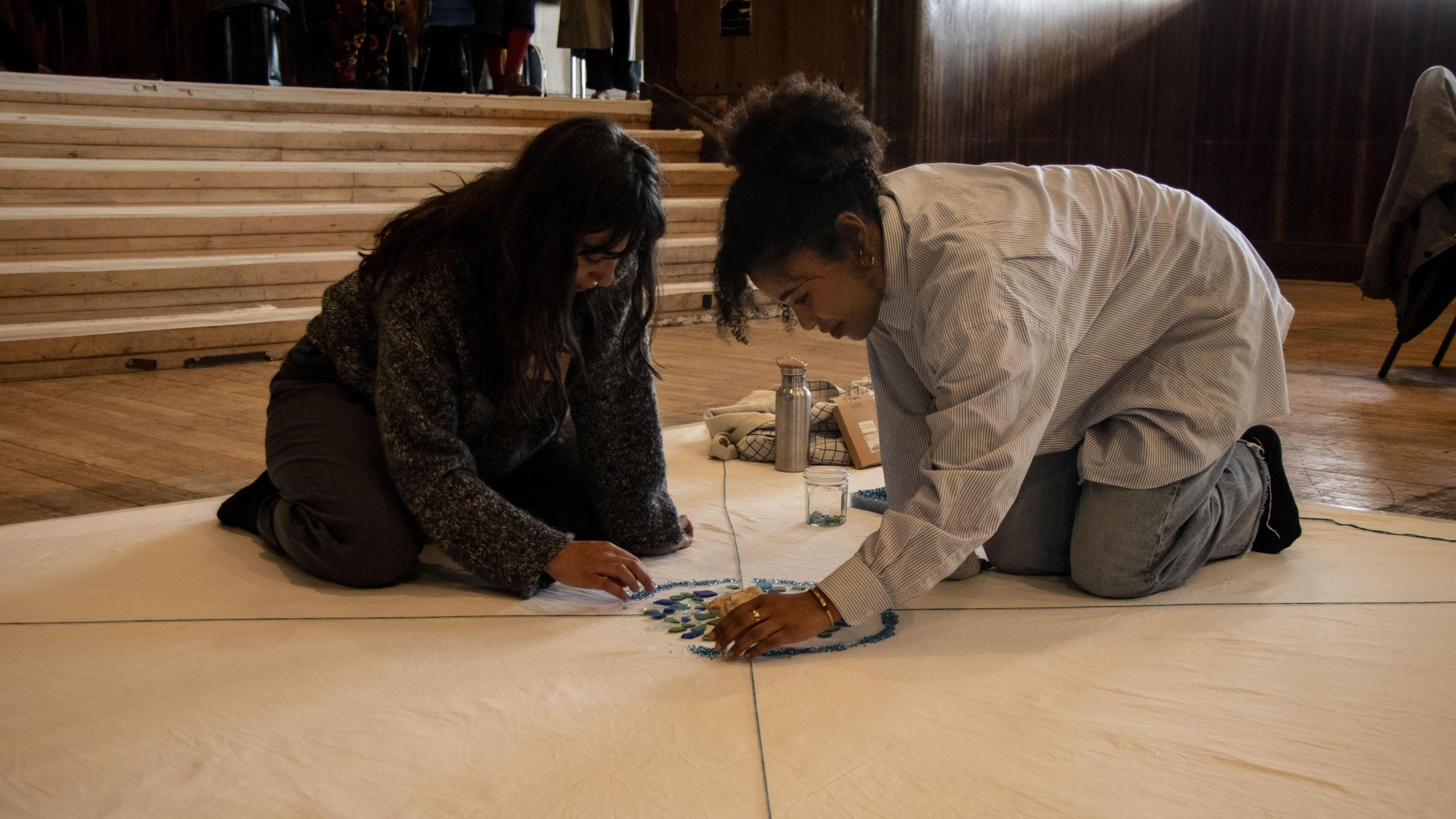
CDE galvanised during lockdown: a strange time of enforced isolation in which opportunities to connect with community and hope were paramount. We held monthly online gatherings, bringing together folks to question the old stories and patterns rearing their heads in times of crisis, and to collectively shape a way out.
“Those gatherings were a salve for my soul – calm, yet purposeful, focused yet open to suggestion. The style of facilitation was welcoming, inclusive and caring. I felt very at home.” – Julie Ward
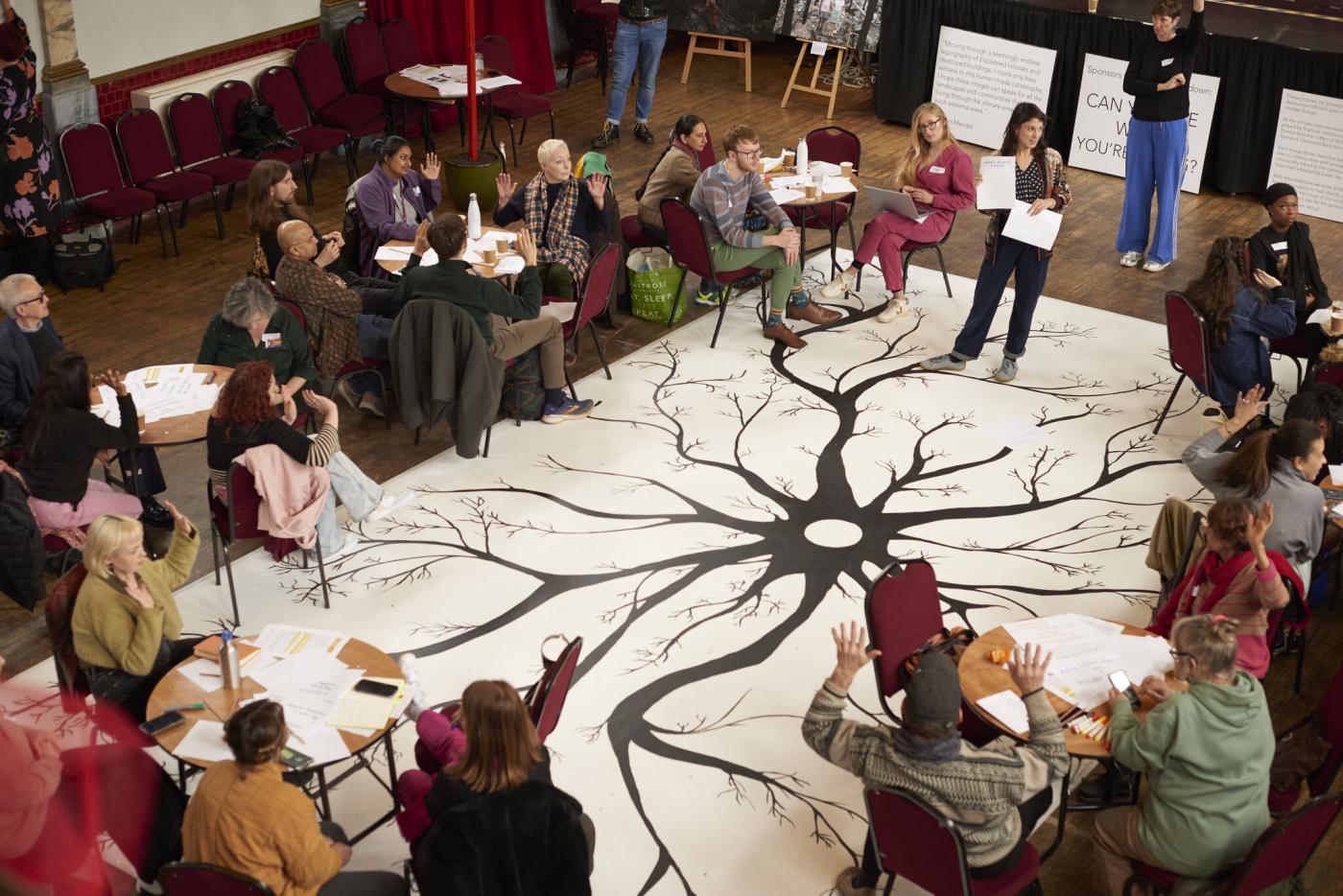
These gatherings have ebbed and flowed over the years, but in the past two years we’ve brought together hundreds of artists and practitioners at our Community Breakfasts, as well as our Open Spaces, to share practice and collectively untangle topics like grief and loss, healing, political advocacy, truth telling, and meaningful collaborations with vulnerable communities.
We have centred care in how we hold these gatherings, allowing people to show up exactly as they need to, carving out space for radical honesty and messy human-ness. By setting this tone for the gatherings, a kind of collective holding establishes itself. We allow people to be vulnerable, and in doing so, build a community of mutual care. This matters because it gives us the courage, self-belief and capacity to be in the world, to continue creating despite the chaos.
“The community breakfasts and the open space events help me to feel connected to the movement and remind me that I am a small part of something bigger. I have come away feeling moved and inspired after hearing about the different practices and projects held and worked by the many hands, hearts and minds of our community.” – Esther Abramson
We offer support to those who are willing to face truths of entanglement, trauma, power grabs and collapse. Our resources, developed by Bridget McKenzie, support Declarers on their individual journeys of declaration and change-making, offering different entry points to meet practitioners wherever they are at. Many of our Declarers have used our guides to shape creative projects and their entire practice, like Declaring artist Louisa Chase.
Together in our place-based and online networks, we encourage and inspire each other to be more radical and active, in our lives, our practice and our organisations.
“One of our most powerful legacies is the kind of mycelium-like network of practitioners that has formed through CDE, facilitated through in-person and online community events over time, people now connected across different contexts and carrying the work forward in their own ways, often quietly but meaningfully. There seems to be another surge of widely shared understanding of the crisis and its deep connection to social justice, which feels like an important shift in the wider cultural landscape.” – Victoria Burns
Growing our flock of birds: engagement and education
So many of our regional Coordinators and Declarers have – and continue to – hold workshops, gatherings and knowledge-sharing events within and beyond the UK, touching all kinds of communities.
From the Rainforest Lifelines ceremony at Orleans House Gallery, that wove together movement, testimony, ritual and poetry to amplify solidarity for Malaysia’s Indigenous rainforest defenders, co-curated by Declarer Gaby Solly; to Jaime Jackson’s collaboration with the Great Imagining and schools in Cannock Chase, through Signs of the Underground, and co-founder Kay Michaels producing a nine-month journey at Stanley Arts in Croydon, for young people to explore and deliver ways of creatively engaging their local community in environmental action.
Julie Ward, co-ordinator of our north east regional hub, describes running pop-up print workshops for young carers conference in Teesside, at a youth-led eco-fest in County Durham, at Newcastle Green Festival and, shortly to come, the BBC Radio One Big Weekender in Sunderland.
“We learned how easy it was for people to have conversations about the climate and nature crises whilst doing something creative with their hands. Julie Ward: Afterwards they walk away proudly holding their print of the CDE logo – a swallow in flight – made with vegetable inks and printed on recycled paper. Our flock of birds are now roosting in hundreds of homes, helping to tell our story.” – Julie Ward
A brave new world: adapting to a constantly shifting landscape
Over the past seven years, the context we are working in has shifted dramatically. Public consciousness of climate change and climate injustice has been rising, thanks to movements like ours, and yet at the same time, strong pushback has been triggered. We’ve faced a crackdown not just on protest, but on imagination and narrative, and the scaling up of Culture Wars.
Over this time, Culture Declares Emergency has been through fallow periods and moments of rebirth; we are constantly shifting and regenerating in response to the capacity and energy of the people behind our movement, and in response to the world we are living in. We’ve formalised our movement into a CIC, our ways of working have moved online and – where possible – back in person again. Amidst these shifts, one thing is for sure: we have grown a network so broad, and cultivated a soil so fertile, that our core values of truth-telling, care-taking and change-making will continue to propagate in boundless ways.
‘The bold early actions made CDE a banner around which people could gather. It was a broad umbrella and all were welcome. I think the energy of CDE has radiated out and lit many touch-papers, with the organic development of the regional and international hubs a good example. It also inspired other declarer movements and sector specific groups. All those ripples are part of our legacy.” – Polly Gifford
